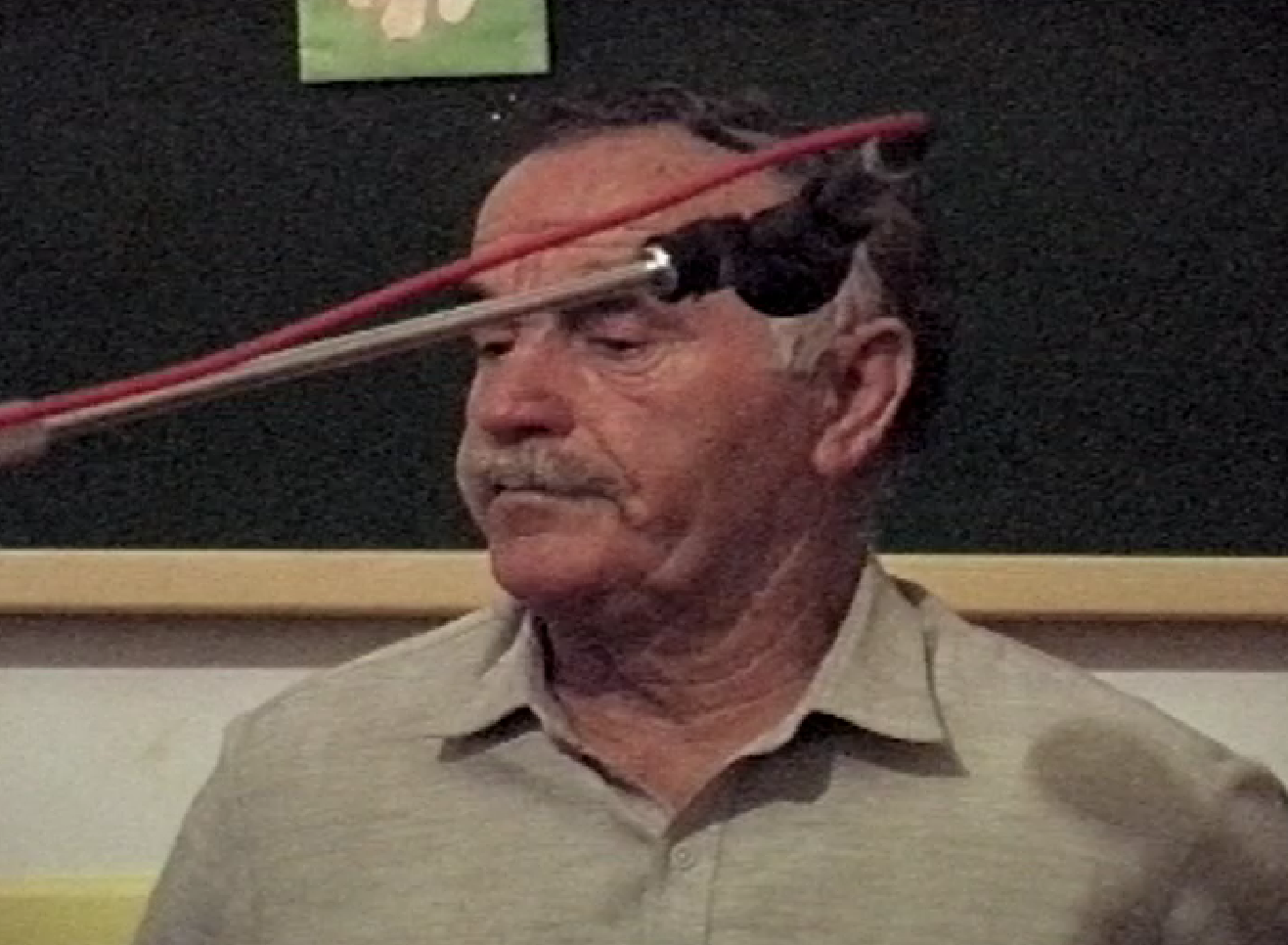
Valasis Nikos
LesvosPlace of birth: Stypsi, Lesvos
Year of birth: 1928
Short biography:
Nikos Valasis was born in 1928, and he was an amateur singer. Except for singing, he also worked as a builder, a profession he learnt from his father. He originally had a crew, and also worked with his brothers; later, his sons joined the business. He took on various construction projects, such as building houses, paving roads in stone, etc, in Stypsi and around Kalloni and Molyvos.
He learnt to sing by listening to older generation singers perform at the local cafés. He enriched his repertoire, however, with songs that he heard on gramophone records, and on the radio (after the 60s): “In my time [between 1940 and 1950] they hand songs on those disks, that turned around [gramophone records]. Amanedes [traditional vocal songs] and songs. Other songs we got from the old folk.”
During his time as an amateur singer, he performed in several villages in Lesvos. Speaking of parties in the cafés of Stypsi, he said: “When I sang them [amanedes] in the cafes [in Stypsi], and I still sing them, you’d see the bottles of ouzo filling up the table. Lots of things got smashed! There were many of us around my age, we were the generation of ’49 [the year they were drafted into the military, for their national service], there were a lot of us in our village. We all became friends, all of us wanted to spend our nights at the café. When we had a party, we had a fine time. When we started the amanedes, the songs, you’d see the bottles, the ouzo, piling up on the table, people would send them over to thank us. Afterwards, when the cafés shut at 12 o’clock, we wanted to go out, to go round the villages singing serenades, amanedes.”
Other events he remembers in villages across Lesvos include:
- In Geloia [Pelopi], parties in cafes, and festivals
- In Ypsilometopo, parties in cafes, and festivals
- In Molyvos, parties in cafes.
- In Mantamado, Kapi, Sykamia, parties in cafes.
On amanedes, and the way he sang them, he said: “Amanedes were traditional songs, what beautiful songs! There is only one tune. [In] other songs, you say a lot [of lyrics], but they must be eastern. In Stypsi it was just the eastern ones. Amanedes, sarkia, kleftika. They call it sarki in Turkey, we call it amane […].
[…] When your voice gets tired, you need to have strength, to carry on, with amanedes. But there are people who can’t handle it. The point is to have strength, to sing all the lyrics. There are Turkish words in them, too, you say ‘mendet’ or ‘are mendet’ and you sing the words of the specific song, as well.”
Images


Video