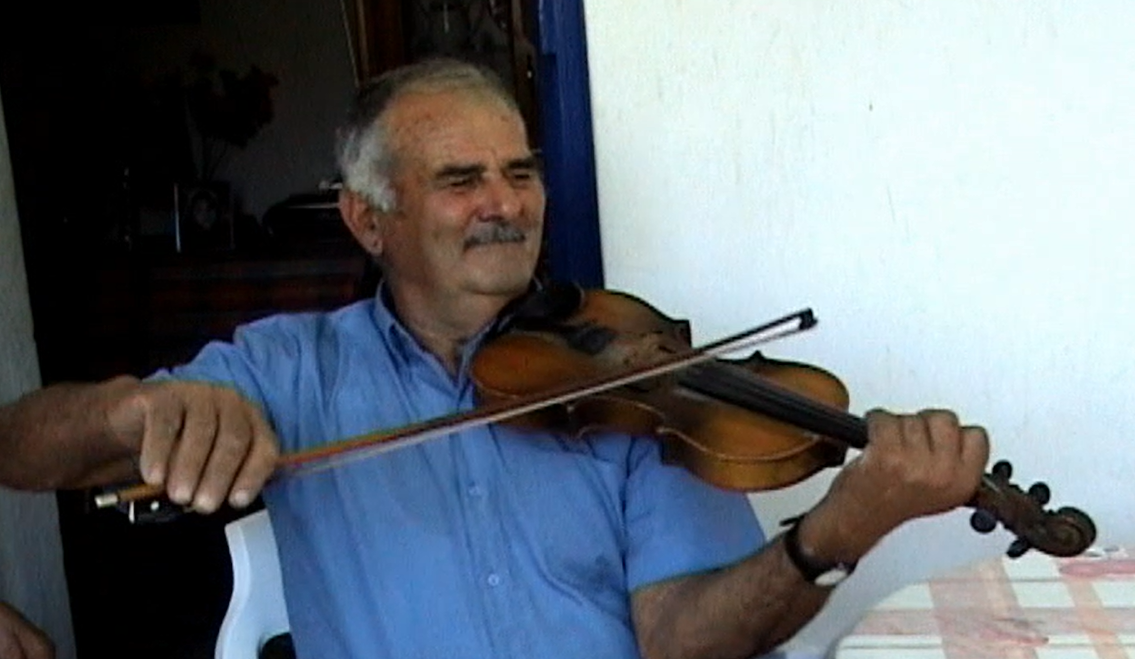
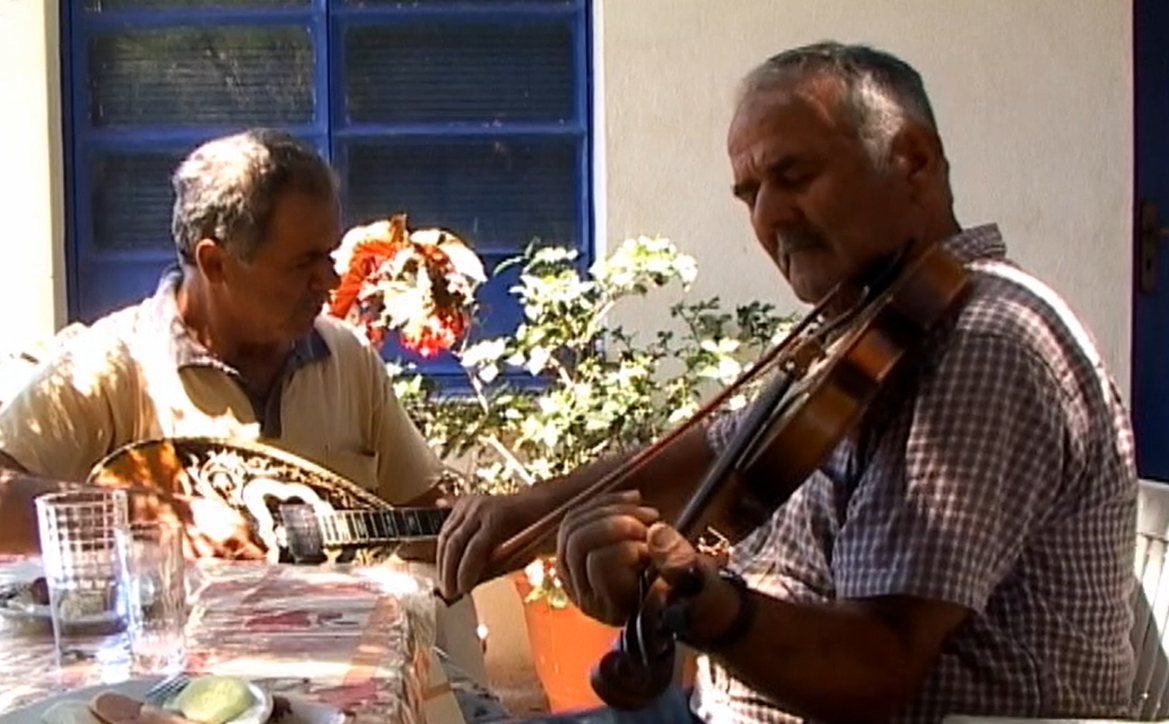
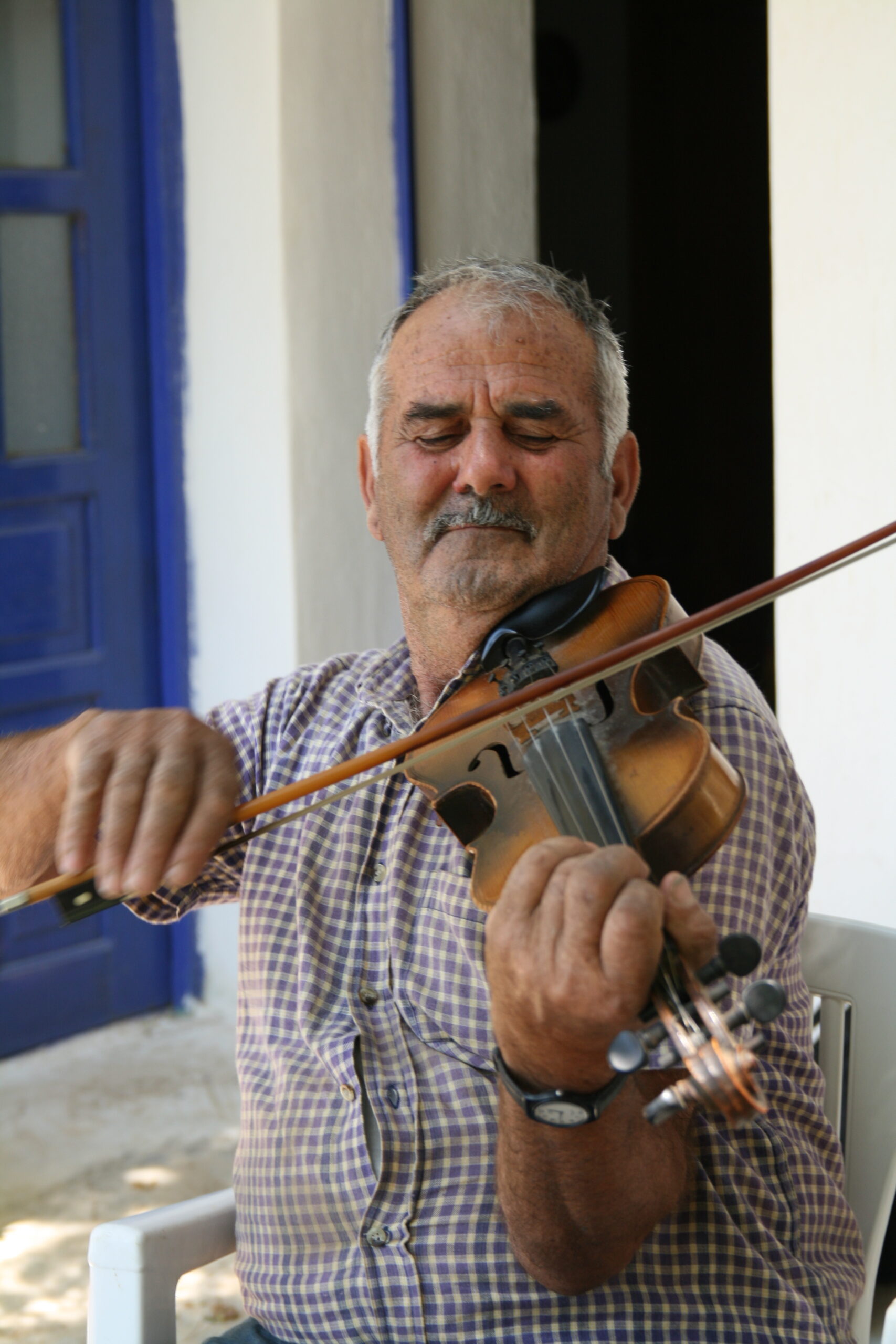
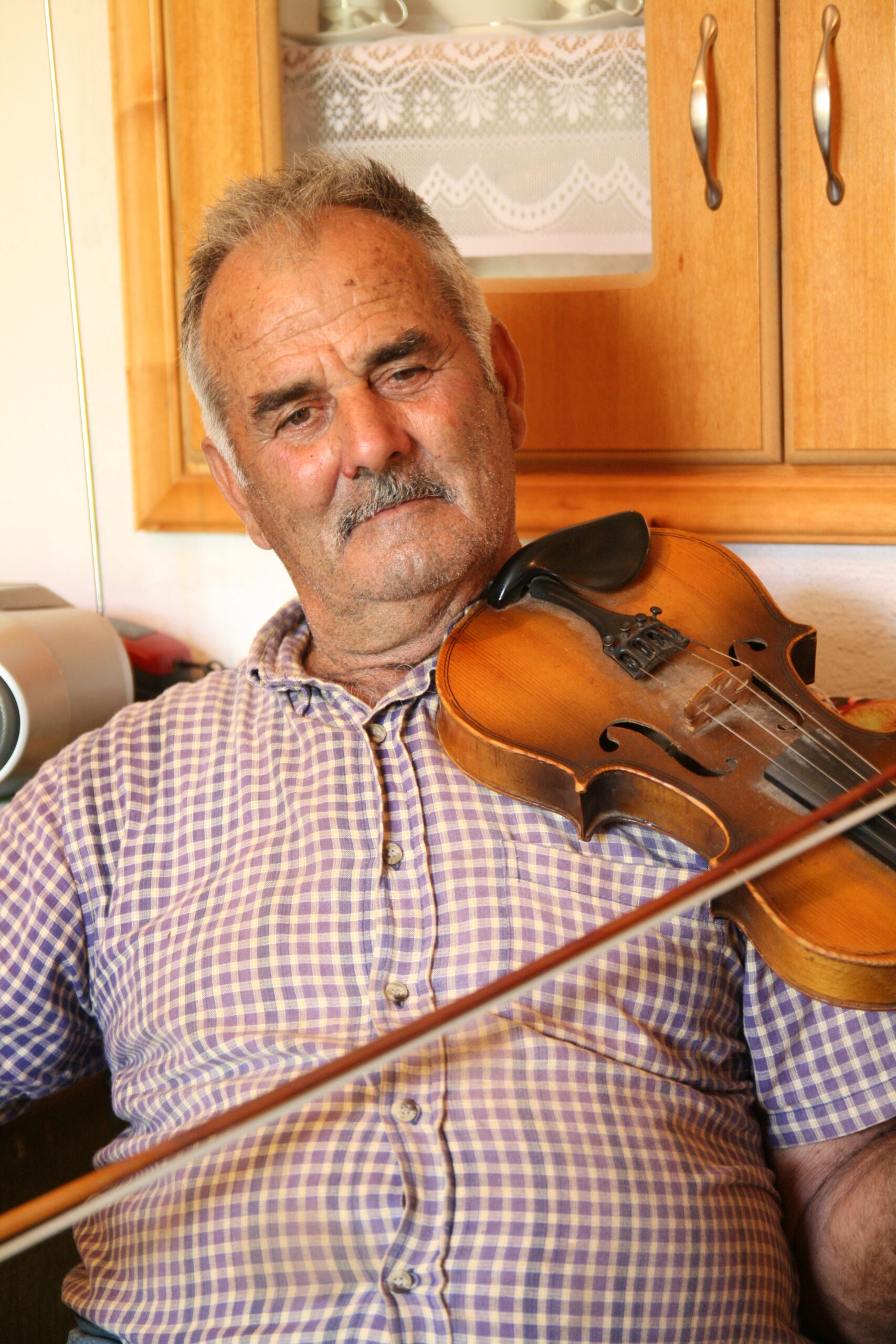
Plystakas Stephanos
IkariaPlace of birth: Amalo, Ikaria
Year of birth: 1934
Short biography:
Stephanos Plystakas is a self-taught musician, with no formal education in music, and plays the violin and the mandolin: «My father’s name is Georgios. My mother’s Aphrodite. I was born in 1934, which makes me 74 years old. I’m ancient […]. I had a mandolin […]. My father had got it for me […] he’d gone to the coal mines, at some point […]. [The violin] was a present from my mother, it was Egyptian […]. My grandfather played the lyre. Yes, the Ikarian lyre. I never met him. I never saw granddad play the lyre […]. He was a farmer, he was a builder […]. My father used to tell me that when he played at a dance, they’d give the musicians loukoumia[1] for payment. You’d play, you know, and they’d give you loukoumia, at the dance. And my father was a young boy, and he’d take the loukoumi and eat it […]. My father had […] he had a store, a cafe. He had a gramophone – my mother had brought it here from Egypt – and the whole of Ikaria would come here to listen to the gramophone, imagine that! And it was a big gramophone, you could hear it from afar. They’d come from Raches, from everywhere, everywhere». His son, who lives in Athens, is also a musician.
Regarding local festivals in the past, he said: «You know how festivals used to be, in those days? People had no way of going out, and 100 people – 50 people would go, and that would be a big festival, you know […]. Now there are more than 3,000 people. To go and play the violin, these days, without equipment? It can’t be done […]. You know, their problem in those days was to secure a loaf of bread. They’d be kings, and dance for days on end. They sang and they danced. The problem was […] that was their obligation. To secure the bread. From there on, it was easy. They’d think, if I get a shirt, I’ll take it off, I’ll wash it, I’ll wear it». On the festivals held in locally in the present day, he said: «There are quite a few. There around 6 festivals, 6-8 festivals […]. Only one or two in the winter, of St. Charalambos and St. Nicholas […]. The festival hires the musician […]. Yes, you play, take a selection and play. People can dance if they want to, and sit down in they want to. The committee pays. No matter if some people said, I paid for you to dance. There is no such thing».
Stephanos Plystakas only performed around his village: «I wouldn’t go elsewhere [to play], as far as Vrakades. Just here, in the village […]. Karginagri, there were a lot of musicians there. Every cafe had its own crowd. There were many people».
The musical tradition of Ikaria includes: «The syrta[2], the Ikariotika[3] – the ones you dance to – Silyvriana[4], politika[5] and nisiotika[6] […] and nisiotika too, yes […]. […] Ah, yes! Many [European]. All night. Often […] I’ll play the polka. The polka’s popular recently […]. Many people dance the polka, many».
On the Ikariotikos, he says: «Yes, each musician plays their own version, usually […]. If they make a change, for example. Improvisation, yes».
[1] Loukoumi (pl. loukoumia): Turkish delight.
[2] Syrtos (pl. syrta): traditional Greek dance.
[3] Ikariotikos (pl. Ikariotika): traditional dance of Ikaria.
[4] Silyvrianos (pl. Silyvriana): a type of syrtos.
[5]Politikos (pl. politika): of Constantinople, traditional Greek dance.
[6] Traditional songs/dances of the Greek islands.
Images
Video